

9 articles
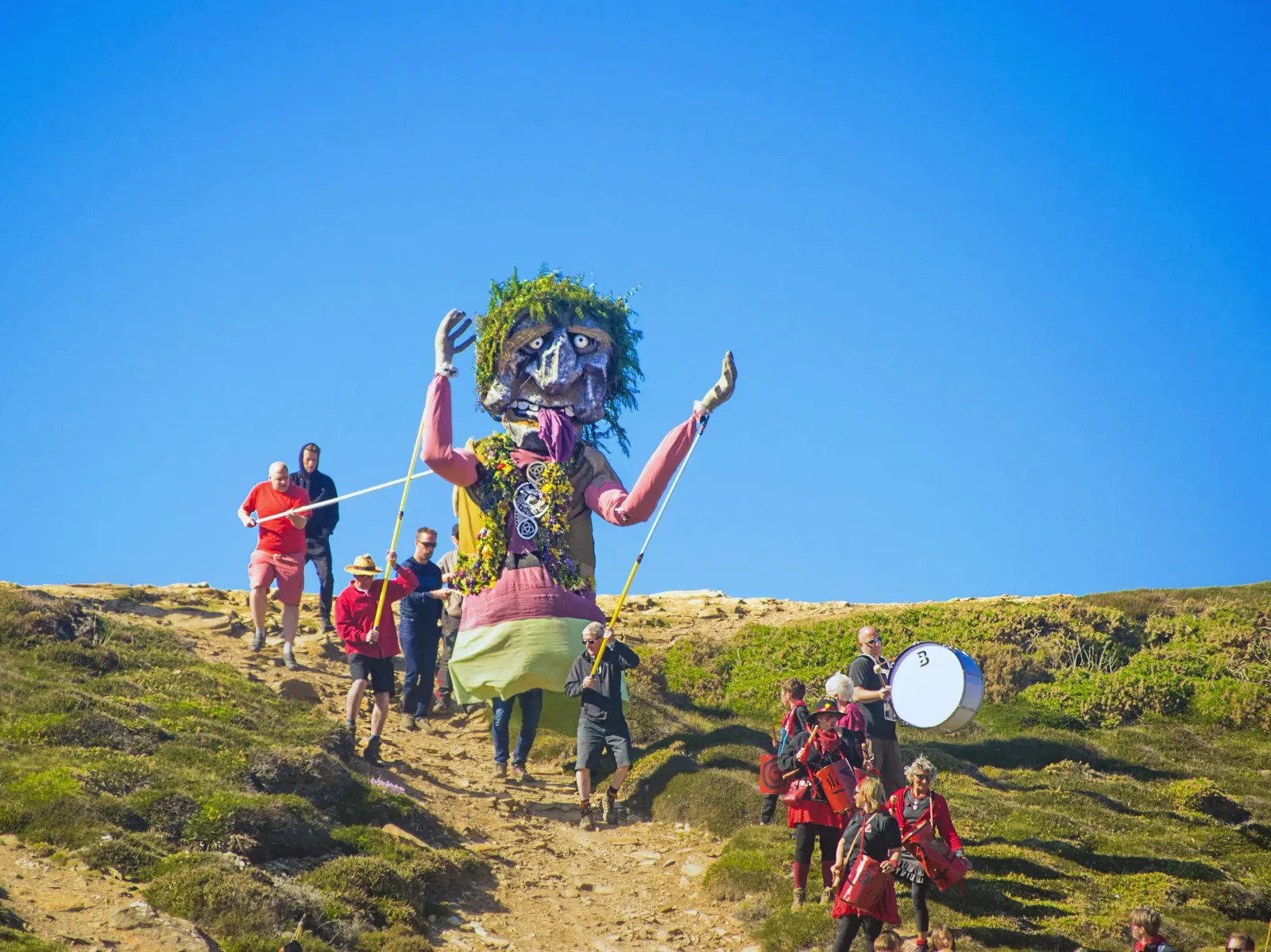
Cornwall has its own unique traditions when it comes to folklore. In the old days people gathered around firesides, spellbound, as they listened to travelling bards reciting fantastic tales of piskies, giants, witches, ghosts, mermaids and strange happenings. These old-time bards were called droll tellers, and their like could not be found anywhere else in the British Isles.
Would you like to hear some of the old droll tellers’ tales? Or perhaps you are curious to learn more about the mysterious creatures that lurk in the wilder corners of our fair peninsula? If so, read on!
Uncle Anthony James of Curry
One of the last droll tellers was ‘Uncle’ Anthony James, who plied his trade in Cornwall in the early 19th century.
Uncle Anthony was a blind old man who travelled Cornwall’s old country lanes alone save for his faithful dog and a young lad to guide him. But everywhere he went people were glad to see him, so keen were they to hear his stories. He was so popular that people paid him for his tales with free food and lodgings.
Unlike the famous 19th century Irish storytellers, Anthony preferred to tell his stories in rhyme or song accompanied by his fiddle. He only rarely used plain speech.1 His was a very old style of storytelling, reminiscent of a medieval minstrel.2
However, droll telling was a dying art. In 1829, James was one of only two still active. By the late1860s, when the folklorist William Bottrell wrote about him, there were none left.3
But, if you could have experienced Uncle Anthony’s performance, what might you have heard?
Cornish Piskies
There are many strange fairy creatures living in Cornwall and most have uniquely Cornish names. We call them spriggans, piskies, bucca and knockers and they often featured in old Uncle Anthony’s tales.
Piskies (Cornish Pixies) frequently appear in Cornish fairy tales. But how will you know a Pisky if you meet one? These are the things you need to watch out for1:
- Piskies are diminutive, often tiny, people.
- However, they can shape change into animals.
- They can even be invisible if they choose.
- They can fly but they have no wings (stories about them having wings were made up by people in late Victorian times).
- Piskies live together in their own communities.
- Their homes are usually underground.
- You are most likely to spot one near stone circles, on remote moorland like Bodmin Moor or perhaps on an isolated beach.
- Piskies enjoy feasting, dancing and merry making.
- But beware! If you accept food or drink from a pisky you risk becoming enchanted!
- Anyone they manage to enchant gets abducted and forced to work as their servant.
- Luckily, you can avoid being enchanted by turning your clothes inside out!
- Even if you escape their charms, the encounter might lead you to fall into a listless melancholy.
- Piskies can be placated with food and drink, especially milk.
- They can even be helpful, but only on their own terms.
Joan the Wad
One particularly famous pisky is Joan the Wad; a will-o-the-wisp type sprite who haunts the countryside near the little fishing village of Polperro. ‘Wad’ seems like a strange name, but it’s an old local word for the torchlight she carries. But if you see her light be careful! If she’s feeling generous, she’ll use her light to guide you to safety. But if she is in a mischievous mood she might play a prank on you and lead you astray!
You’d better watch out if you are ever in the area, since old Joan also likes to sneak up on people to tickle and pinch them!4
Spriggans
Piskies can certainly be mischievous, but their cousins the spriggans have a more malevolent nature. Be especially careful should you ever meet one of those!
“I’ll tell you a tale, an you’ve patience to hear an,
‘Bout the Spriggans, that swarm around Partinney still”4
These are the opening lines of an old Cornish droll called The Spriggans Child. ‘Partinney’ is the old name for ‘Bartinney’ – a remote hillside in the wilds of west Cornwall. This old tale concerns Anne Tregeer, whose child is abducted by spriggans and substituted with a changeling.1 This is typical of the kind of cruel mischief they can get up to.
Spriggans are small, like piskies, but they have the supernatural power to ‘grow large’ if they wish.1 Aside from abducting children, spriggans don’t take kindly to people interfering with their affairs. If they catch you spying on them or, worse, trying to steal their treasure they are likely to transform into large, horrific monsters and chase after you!3
Knockers
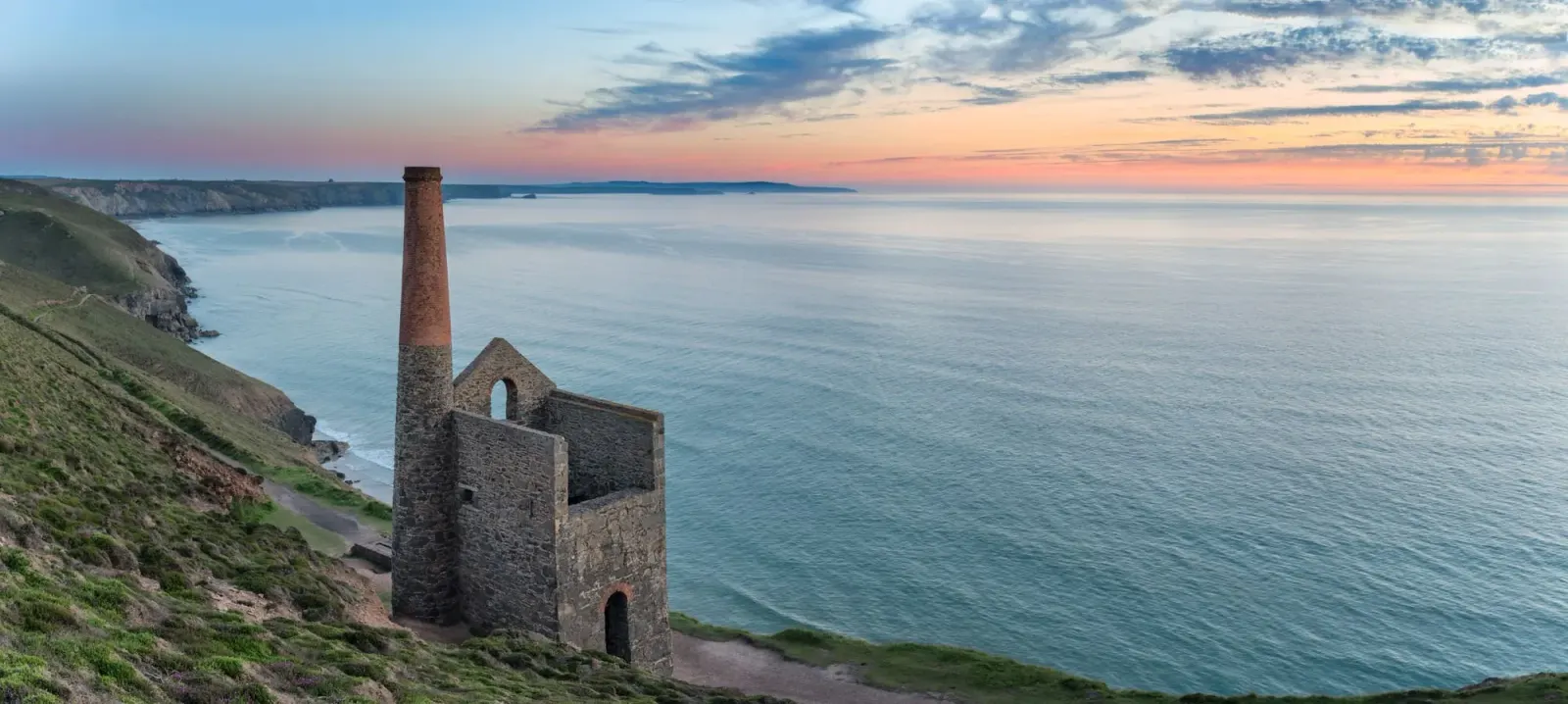
Cornwall is famous for its tin mines. You see many of them dotted around the rugged Cornish landscape at places like Botallack, Cape Cornwall or Geevor. But have you ever wondered what strange creatures might lurk deep down in these old mines? Should you ever visit one, watch out for knockers!
Back when the mines were thriving, these strange little creatures often helped the miners. However, just like piskies, they can be capricious.
In one tale they agreed to lead a miner to a rich vein of tin in exchange for a share in his profits. As long as the miner kept his side of the bargain, he continued to prosper. Alas, when he finally died, his greedy son decided to keep all the profit for himself. Ill luck swiftly followed, and the grasping young fellow died in poverty.1
Knockers are diminutive fellows, rather like piskies, but have the appearance of wizened old men.3 When well-treated they help find riches and warn miners of dangers underground. But if they are feeling grumpy, they play cruel tricks and bring ill fortune.
Fun Fact: Many Cornish miners emigrated to the USA in the 19th century, bringing their belief in knockers with them. Miners across the American west now call them ‘Tommyknockers’.1
The Mermaid of Zennor
Have you ever seen a mermaid? You might think not but, did you know, some mermaids can disguise themselves as women and walk on land? No? Well, let me tell you the tale of the Mermaid of Zennor.
A long time ago, the little St Senara’s church in Zennor was visited by a beautiful young woman. No one had seen her before. No one knew who she was or where she came from. In the following years she returned from time to time but never seemed to age.
A young parishioner, Matthey Trewhella, became so entranced with her that one day he left with the woman. Neither he nor the mysterious woman ever returned.
Later a passing ship’s captain encountered a mermaid in local waters. It seemed that the mysterious woman had been the very same mermaid in disguise. She had bewitched Matthey into joining her beneath the waves.5
Cornish Mermaids
Cornwall has 422 miles of coastline5 and a long history of fishing, sea trade, smuggling and even piracy. So, perhaps it’s not surprising to find that mermaids are quite common around the Cornish coast.
Whilst mermaids can be helpful and friendly, they are also dangerous. Liaisons between people and merfolk are often doomed as mermaids are quick to take revenge when offended.
On one occasion a local man from Padstow shot a mermaid who spurned his advances. To get her revenge she used her magic to cause the sandbar known as the Doom Bar to form at the mouth of the River Camel, damaging the port’s prosperity.3
The Mermaid’s Comb and Mirror
If you visit Zennor’s church today, you can see an old wooden bench (15th century), decorated with a mermaid carving. Perhaps the story inspired the carving but, more likely, the carving inspired the story.5
Mermaid images appear more often than you might think in medieval churches. But how, you might be wondering, did mermaids come to be so closely associated with combs and mirrors? Originally, in the Middle Ages these images were understood as symbols for vanity, intended as a moral warning.7 Overtime this original meaning was lost but they continued to appear in mermaid tales.
Lost Lyonesse
Did you know that some believe there is a lost land, just off the Cornish coast, submerged beneath the sea?
The land of Lyonesse is amongst one of the most enigmatic Cornish legends. It was first mentioned by Malory in Le Morte d’Arthur as being the home of Sir Tristan.8
William of Worcester, writing in the 15th century, was the first to tell of a lost land submerged beneath the waves. It boasted over 140 churches and extensive woodlands: extending all the way from Saint Michael’s Mount, Marazion, as far out as the Isles of Scilly. Later, in 1584, John Newton claimed the lost land William described must have been Lyonesse.
They say that when Lyonesse was engulfed by the deluge there was only one survivor. A man named Trevelyan escaped to safety on the back of a fast white horse. To this day the Trevelyan coat of arms features a white horse emerging from the waves.9
Tintagel and King Arthur
There are quite a few Arthurian Legends set in Cornwall. The tale of Sir Tristan is just one. But did you know that Arthur was born in Cornwall?
According to Geoffrey of Monmouth’s History of the Kings of Britain, Tintagel castle was King Arthur’s birthplace.10
In Geoffrey’s tale, Gorlois, Duke of Cornwall, was an ally of Arthur’s father, Uther Pendragon. However, Uther became so besotted with Gorlois’ wife Ygerna that the two went to war over her. To keep Ygerna safe, Gorlois sent her to Tintagel castle.
Uther knew he couldn’t easily take the castle by force, so he turned to sorcery. Merlin used magic to disguise Uther as Gorlois, allowing him to enter Tintagel unchallenged. Even Ygerna herself suspected nothing and welcome him as her husband. As a result King Arthur was conceived at Tintagel.
In another tale Arthur is said to have returned Excalibur to the Lady of the Lake at Dozmary Pool on Bodmin Moor. However, this story originated in a poem by Lord Tennyson in 1869, so it is nowhere near as old as many people think.11
The Land of the Giants
Cornwall has many tales of giants. So much so that one Victorian antiquarian dubbed it ‘The Land of Giants.'1
Writing in the 12th century, Geoffrey of Monmouth tells us that Cornwall once had a great many giants.10 At the time they were led by a monstrous chieftain, known as Gogmagog. This monster tried to kill the early human settlers but was defeated and hurled into the sea by the Cornish hero Corineus.
Some of the better-known Cornish giants include Blunderbore, who terrorized St. Ives before finally being slain by Tom of Towednack. Another is Trebiggan, one of the biggest, who enjoys dining on children for his breakfast! St Michael’s Mount is famously associated with not one, but possibly two, giants (depending on the story) – Cormoran and his wife Cormelian.3
Cormoran and Jack the Giant Killer
In the tale of Jack the Giant Killer, Cormoran is one of the giants Jack kills. According to local tradition, Jack dug a deep, concealed, pit. He then tricked the giant into walking into the trap and falling to his doom. The locals gratefully rewarded Jack with a sword and a magnificent belt.5
Jan Tregeagle
Back in the 17th century, Bodmin had a rather unpleasant magistrate by the name of Jan Tregeagle.3 He was notorious for corruption and malpractice. The locals believed he’d murdered more than one wife, although no one could prove it. Some even whispered darkly that old Tregeagle had made a Faustian pact with the Devil.
He was bad enough in life, but it was in death that Tregeagle achieved true notoriety. In a court case, shortly after his death, a local man foolishly called him back from the grave to bear witness. Much to everyone’s horror, the ghost arose and gave testimony (honestly for once) before declaring ominously:
“thou hast … found it easy to bring me from the grave, but thou wilt not find it so easy to put me away.”12
Sure enough, Tregeagle’s ghost haunted the poor fellow until, at last, exorcists had to be called. Tregeagle was banished to haunt Dozmary Pool until he could empty it using only a limpet shell with a hole in it. Eventually, however, he succeeded, and so a local parson had to bind the unquiet spirit a second time.
These days Tregeagle’s ghost haunts Gwenvor Cove. He can never be free until he successfully weaves ropes from sand (thankfully this has so far proved impossible). Nevertheless, should you ever visit the Cove, you might hear Tregeagle’s damned soul howling in the wind.12
A Pasty and a Pint
So, the next time you find yourself in a Cornish hostelry, enjoying a pasty and a pint, spare a thought for Uncle Anthony and the tales of old Cornwall.
Article Sources
- James, RM. (2022). The Folklore of Cornwall, the oral tradition of a Celtic nation. Exter: University of Exeter Press[↩]
- Southworth, J (1989). The English Medieval Minstrel. Woodbridge: The Boydell Press[↩]
- O’Connor, M. (2025). The Little History of Storytelling in Cornwall. Cheltenham: The History Press[↩]
- Simpson J. & Roud S. (2000). Oxford Dictionary of English Folklore. Oxford: Oxford University Press[↩]
- quoted in James, RM. (2022). The Folklore of Cornwall, the oral tradition of a Celtic nation. Exter: University of Exeter Press., p30[↩]
- Westwood, J & Simpson, J (2005). The Lore of the Land, a guide to England’s legends. London: Penguin Books
- Wood, J (2018), Fantastic Creatures in Mythology and Folklore, from medieval times to the present day. London, Bloomsbury
- Malory, Sir T. (1969). Le Morte D’Arthur. London: Penguin Classics. Vol 1
- Watts, P. (2024). Myths and Legends of the Medieval World. Barnsley: Pen & Sword Books
- Monmouth, G of. (1966). The History of the Kings of Britain. London: Penguin Classics
- Kowethas Ertach Kernow – Sharing Cornwall’s historic, cultural & environmental heritage. (2024). Ertach Kernow – Well-known Cornish places with myths and legends.[online] Available at: https://www.cornwallheritage.com/ertach-kernow-blogs/well-known-cornish-places-with-myths-and-legends Cornwall Heritage
- Gutenberg.org. (2025). The Project Gutenberg eBook of Traditions and Hearthside Stories of West Cornwall, Second Series, by William Bottrell.[online] quote on p.224. Available at: https://www.gutenberg.org/files/41761/41761-h/41761-h.htm Gutenberg.org
Frequently Asked Questions
Cornish superstitions include strong beliefs in piskies (pixies), mermaids, and knockers—spirits said to live in mines. It was considered bad luck to disrespect the sea, whistle underground, or ignore local folklore, while good luck came from respecting nature, mining traditions, and ancient holy wells.
Traditionally piskies, spriggans, knockers, giants and mermaids were Cornwall’s best-known mythical creatures. Cornish fairies are diminutive sprites, although spriggans have the power to grow into large monstrous creatures when they get angry. More recently, the Beast of Bodmin Moor has joined the list. Those who say they have seen the beast describe it as a large black cat, perhaps a panther.
Cornwall is home to many kinds of fairies, including piskies, spriggans, knockers, bucca and brownies. Piskies are small, mischievous sprites who live underground in wild places like moorlands, or near ancient megaliths. Bucca are sea sprites, who you might encounter on a beach. Spriggans are much like piskies but can transform into large monstrous creatures when angry. Knockers are small, wizened goblin-like creatures that live in tin mines.
Cornwall, along with Ireland, Wales and Scotland all retain something of their ancient Celtic mythology. Stories of giants and fairies of various kinds are popular with all these peoples. The Cornish share most in common with the Welsh and the Bretons in France, due to their shared Brittonic heritage. The oldest stories of King Arthur, originate from these three peoples.
Cornish myths concerning giants, ghosts, mermaids and fairy folk (such as the native piskies and spriggans) are very common. Several Arthurian myths are also set in Cornwall. Indeed, Tintagel Castle is said to be Arthur’s birthplace. More recently, stories of a mysterious beast on Bodmin Moor have added to Cornwall’s folklore.
The mythical land off Cornwall is Lyonesse – a mysterious lost land, said to lie beneath the waves between St Michael’s Mount and the Isles of Scilly. They say this ancient land was consumed beneath a huge deluge many years ago. Only one man survived, a fellow named Trevelyan. He only just managed to ride to safety on a fast white horse.
If you ever visit the castle on St Michael’s Mount, look out for a heart shaped stone in the cobbles on the way up. They say it is the heart of Cormoran the giant! [30] Another good place to look is Bolster’s Bank by St Agnes Beacon in west Cornwall – it’s a great earthwork built by a giant called Bolster. There’s even supposed to be a giant named Sneezy Snatcher living near Penzance.
King Arthur and Sir Tristram of the Round Table from Arthurian Lore. Jack the Giant Killer was also active in Cornwall, most famously slaying Cormoran, the giant of St Michael’s Mount. Cornwall’s most infamous ghost, Jan Tregeagle, haunts Gwenvor Cove. Joan the Wad is a Cornish pisky with will-o-the-wisp type powers. Cornwall is also famous for the Mermaid of Zennor.
The mermaid of Zennor is the best known. But Cornish folklore has many stories about mermaids. There are tales of mermaids in Lamorna, Seaton, Padstow, Coverack and Sennon Cove to name but a few places. It is dangerous to fall in love with a mermaid. Those they bewitch have been known to disappear beneath the waves.
Knockers are mine spirits believed to warn miners of danger by knocking sounds underground.
Folklore helps preserve Cornish identity, history, and traditions, especially linked to the sea and mining.
Cornish folklore developed from Celtic traditions, early Christianity, and Cornwall’s mining and maritime history.
Written by
Paul Watts is a local writer based in Launceston with a keen interest in history and folklore, having studied A History of Folklore at Oxford University. He is the author of Myths and Legends of the Medieval World (Pen & Sword Books) as well as a leading medieval history blog (named a ‘Top blog’ by Feedspot in 2025)
9 articles published on Cornwall.co.uk
Read more from Paul Watts →
Comments
No comments yet — be the first to share your thoughts.
Leave a comment
Your email won’t be published. Comments are checked before they appear.